Resurrecció
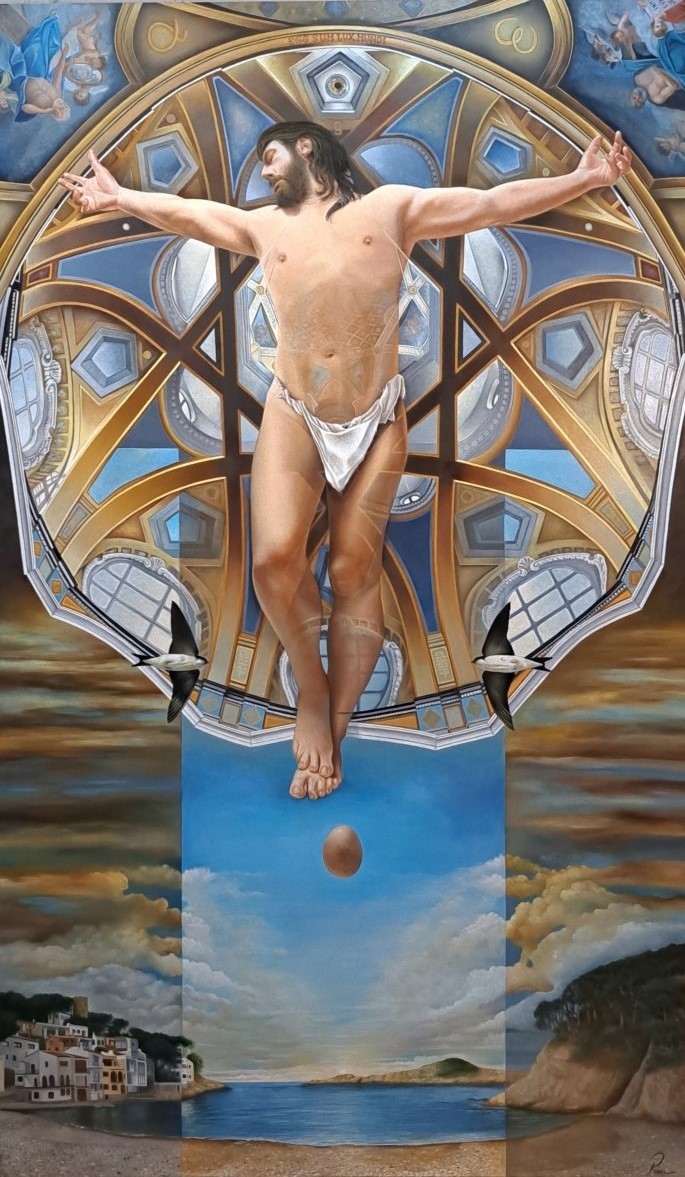
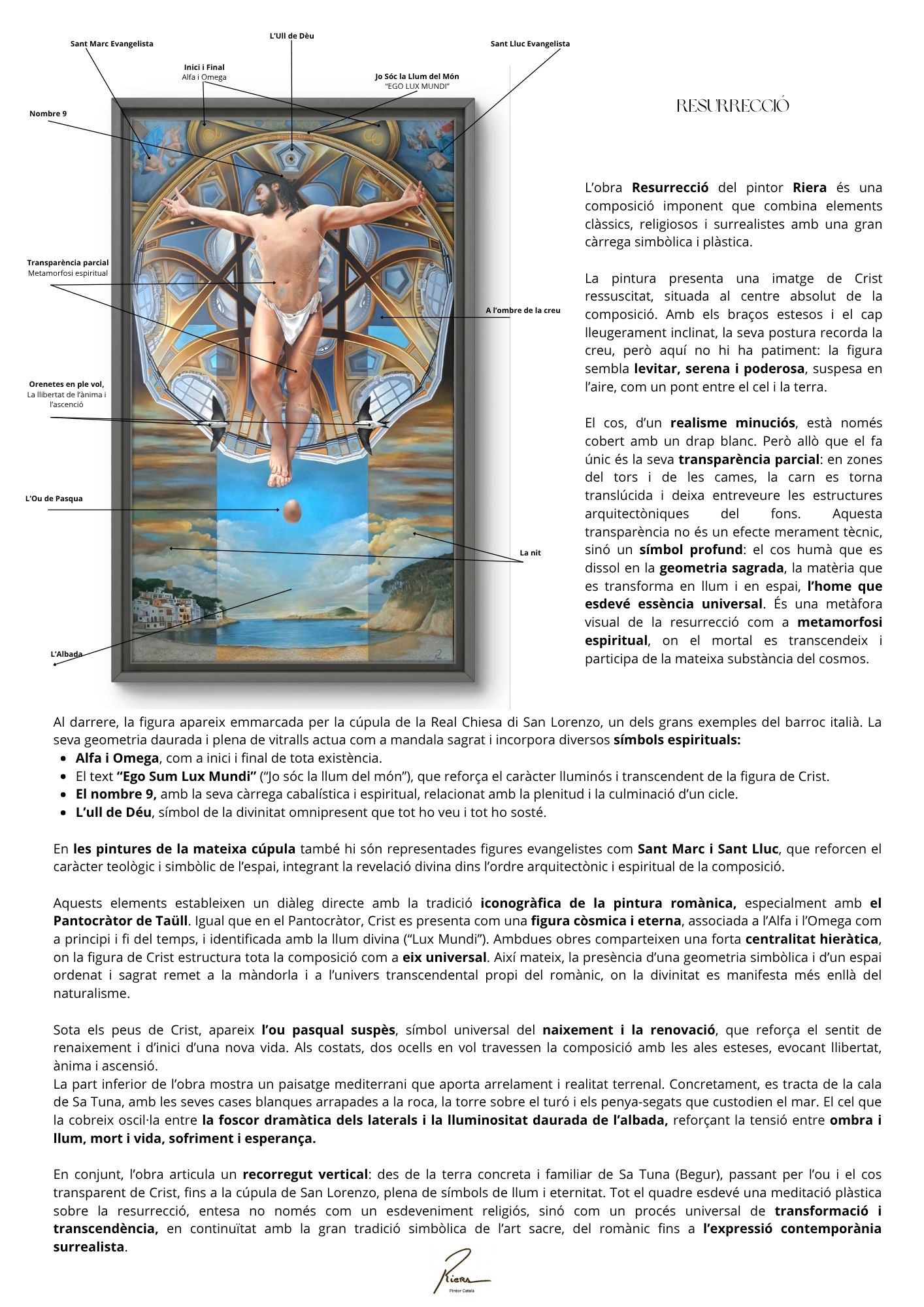
L’obra Resurrecció del pintor Riera és una composició imponent que combina elements clàssics, religiosos i surrealistes amb una gran càrrega simbòlica i plàstica.
Figura central
El Crist ocupa el centre absolut de la composició, suspès a l’aire, amb els braços estesos en creu i el cap lleugerament inclinat cap a l’esquerra.
El cos nu, només cobert per un drap blanc, està pintat amb un realisme minuciós, destacant la musculatura i la llum que acarona la pell.
No és la imatge clàssica del crucificat en sofriment, sinó una figura serena i poderosa, que sembla més levitar que patir.
Els peus apunten cap a un ou suspès en l’aire, símbol universal de la creació, la vida i el renaixement.
Fons arquitectònic
El Crist es troba sobre un entramat geomètric que recorda una cúpula renaixentista vista des de sota, amb arcs, vitralls i motius daurats.
Aquest element arquitectònic actua com a mandala o rosetó, convertint-se en un espai sagrat que envolta i sosté la figura.
L’efecte és quasi tridimensional: la perspectiva fa que sembli que l’espectador mira cap amunt, cap a una cúpula que s’obre al cel.
Elements simbòlics
-L’ou, just sota els peus de Crist, és una metàfora poderosa: del buit a la vida, de la mort al renaixement.
-Els ocells (a l’esquerra i a la dreta), que travessen la composició amb les ales obertes, evoquen llibertat, espiritualitat i ascensió.
-El cel es divideix en dos espais: a la dreta, un horitzó lluminós amb núvols daurats; a l’esquerra, un cel més fosc i dramàtic, amb núvols carregats. Aquesta oposició recorda la lluita entre vida i mort, ombra i llum, humanitat i divinitat.
Paisatge terrenal
A la part inferior es desplega un paisatge mediterrani: a l’esquerra, un poble costaner amb cases blanques i un castell sobre el turó; a la dreta, un penya-segat i vegetació.
Al centre, el mar tranquil reflecteix el cel i condueix la mirada cap a l’infinit. És un retorn a l’origen, un paisatge proper i humà que contrasta amb la dimensió celestial de la figura central.
Composició i significat
L’estructura vertical guia l’ull des de la terra fins al cel, creant un recorregut espiritual: de la matèria al símbol, de la mort a la resurrecció.
L’obra és un pont entre tradició i modernitat: dialoga amb la iconografia religiosa clàssica però la reformula amb un llenguatge contemporani, gairebé oníric i surreal.
👉 En conjunt, l’obra presenta una imatge imponent de Crist ressuscitat, situada al centre absolut de la composició. Amb els braços estesos i el cap lleugerament inclinat, la seva postura recorda la creu, però aquí no hi ha patiment: la figura sembla levitar, serena i poderosa, suspesa en l’aire, com un pont entre el cel i la terra.
El cos, d’un realisme minuciós, està només cobert amb un drap blanc. Però allò que el fa únic és la seva transparència parcial: en zones del tors i de les cames, la carn es torna translúcida i deixa entreveure les estructures arquitectòniques del fons. Aquesta transparència no és un efecte merament tècnic, sinó un símbol profund: el cos humà que es dissol en la geometria sagrada, la matèria que es transforma en llum i en espai, l’home que esdevé essència universal. És una metàfora visual de la resurrecció com a metamorfosi espiritual, on el mortal es transcendeix i participa de la mateixa substància del cosmos.
Al darrere, la figura apareix emmarcada per la cúpula de la Real Chiesa di San Lorenzo de Torí, un dels grans exemples del barroc italià. La seva geometria daurada i plena de vitralls actua com a mandala sagrat i incorpora diversos símbols espirituals:
Alfa i Omega, com a inici i final de tota existència.
El text “Ego Sum Lux Mundi” (“Jo sóc la llum del món”), que reforça el caràcter lluminós i transcendent de la figura de Crist.
El nombre 9, amb la seva càrrega cabalística i espiritual, relacionat amb la plenitud i la culminació d’un cicle.
L’ull de Déu, símbol de la divinitat omnipresent que tot ho veu i tot ho sosté.
Sota els peus de Crist, apareix un ou suspès, símbol universal del naixement i la renovació, que reforça el sentit de renaixement i d’inici d’una nova vida. Als costats, dos ocells en vol travessen la composició amb les ales esteses, evocant llibertat, ànima i ascensió.
La part inferior de l’obra mostra un paisatge mediterrani que aporta arrelament i realitat terrenal. Concretament, es tracta de la cala de Sa Tuna, a la Costa Brava, amb les seves cases blanques arrapades a la roca, el castell sobre el turó i els penya-segats que custodien el mar. El cel que la cobreix oscil·la entre la foscor dramàtica de l’esquerra i la lluminositat daurada de la dreta, reforçant la tensió entre ombra i llum, mort i vida, sofriment i esperança.
En conjunt, l’obra articula un recorregut vertical: des de la terra concreta i familiar de Sa Tuna, passant per l’ou i el cos transparent de Crist, fins a la cúpula de San Lorenzo, plena de símbols de llum i eternitat. Tot el quadre és una meditació plàstica sobre la resurrecció, entesa no només com un esdeveniment religiós, sinó com un procés universal de transformació i transcendència.
Resurrection, by the painter Riera, is an imposing composition that combines classical, religious, and surrealist elements with a strong symbolic and plastic charge.
Central Figure
Christ occupies the absolute center of the composition, suspended in the air, with his arms outstretched in the shape of a cross and his head slightly inclined to the left.
The nude body, covered only by a white cloth, is rendered with meticulous realism, highlighting the musculature and the light gently caressing the skin.
This is not the classic image of the suffering crucified Christ, but rather a serene and powerful figure, one that seems to levitate rather than endure pain.
His feet point toward an egg suspended in midair, a universal symbol of creation, life, and rebirth.
Architectural Background
Christ is set against a geometric structure reminiscent of a Renaissance dome seen from below, with arches, stained glass, and gilded motifs.
This architectural element functions like a mandala or rose window, becoming a sacred space that surrounds and supports the figure.
The effect is almost three-dimensional: the perspective gives the impression that the viewer is looking upward, toward a dome opening to the sky.
Symbolic Elements
The egg, positioned just beneath Christ’s feet, is a powerful metaphor: from emptiness to life, from death to rebirth.
The birds (to the left and right), crossing the composition with open wings, evoke freedom, spirituality, and ascension.
The sky is divided into two distinct areas: on the right, a luminous horizon with golden clouds; on the left, a darker, more dramatic sky with heavy clouds. This opposition recalls the struggle between life and death, shadow and light, humanity and divinity.
Earthly Landscape
In the lower section, a Mediterranean landscape unfolds: on the left, a coastal village with white houses and a castle atop a hill; on the right, a cliff and vegetation.
At the center, the calm sea reflects the sky and leads the eye toward infinity. It is a return to origins—a familiar, human landscape that contrasts with the celestial dimension of the central figure.
Composition and Meaning
The vertical structure guides the eye from earth to sky, creating a spiritual journey: from matter to symbol, from death to resurrection.
The work acts as a bridge between tradition and modernity: it engages in dialogue with classical religious iconography while reformulating it through a contemporary, almost dreamlike and surreal visual language.
The work presents an imposing image of the resurrected Christ, positioned at the absolute center of the composition. With arms outstretched and head slightly inclined, his posture recalls the cross, yet here there is no suffering: the figure appears to levitate, serene and powerful, suspended in the air like a bridge between heaven and earth.
The body, rendered with meticulous realism, is covered only by a white cloth. What makes it unique, however, is its partial transparency: in areas of the torso and legs, the flesh becomes translucent, allowing the architectural structures of the background to show through. This transparency is not merely a technical effect, but a profound symbol: the human body dissolving into sacred geometry, matter transforming into light and space, humanity becoming universal essence. It is a visual metaphor for resurrection as spiritual metamorphosis, in which the mortal transcends itself and participates in the very substance of the cosmos.
Behind the figure, Christ is framed by the dome of the Real Chiesa di San Lorenzo in Turin, one of the great masterpieces of Italian Baroque architecture. Its golden geometry, filled with stained glass, functions as a sacred mandala and incorporates several spiritual symbols:
Alpha and Omega, representing the beginning and the end of all existence.
The inscription “Ego Sum Lux Mundi” (“I am the light of the world”), reinforcing the luminous and transcendent nature of Christ.
The number 9, with its cabalistic and spiritual resonance, associated with fullness and the completion of a cycle.
The Eye of God, symbol of an omnipresent divinity that sees and sustains all things.
Beneath Christ’s feet appears a suspended egg, a universal symbol of birth and renewal, reinforcing the idea of rebirth and the beginning of a new life. On either side, two birds in flight cross the composition with wings outstretched, evoking freedom, the soul, and ascension.
The lower part of the work depicts a Mediterranean landscape that provides grounding and earthly reality. Specifically, it represents the cove of Sa Tuna on the Costa Brava, with its white houses clinging to the rock, the castle atop the hill, and the cliffs guarding the sea. The sky shifts from dramatic darkness on the left to a golden luminosity on the right, heightening the tension between shadow and light, death and life, suffering and hope.
Overall, the work articulates a vertical journey: from the concrete, familiar land of Sa Tuna, through the egg and the transparent body of Christ, up to the dome of San Lorenzo, filled with symbols of light and eternity. The entire painting is a visual meditation on resurrection, understood not only as a religious event, but as a universal process of transformation and transcendence.